|
Sudoku Puzzles
Sudoku refers to a number placement puzzle also known as Number
Place in America. The name is Japanese; the kanji it is written
in implies "multiple isolations." The puzzle seems to have
first been published in the U.S. (likely by Dell, which uses the Number
Place name) before being noticed and then popularised in Japan
by Nikoli, which uses the Sudoku name. Bringing the process full-circle,
Kappa reprints Nikoli Sudoku in GAMES Magazine under the name Squared
Away. It has also been an instant success in the London newspaper
The Times, and is often included in puzzle anthologies, such as The
Giant 1001 Puzzle Book (under the title Nine Numbers).
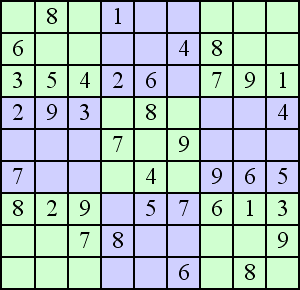
The puzzle is played on a grid, most frequently made
up of 3x3 subgrids - "regions" - and starting with various numbers
in the range of 1 through 9 given in some cells - "givens."
The goal is to fill in the empty cells, one number in each, so that every
column, row, and region each contains the numbers 1 through 9 once. Therefore,
each number in the solution is unique - or alone - in each of three "directions,"
hence "multiple isolations." The attraction of the puzzle is
that the completion rules are so simple and yet the overall task can be
difficult. Each puzzle can be ranked in terms of difficulty depending
upon how many numbers are given and how easy it is to logically determine
subsequent numbers once the puzzle has been started.
The description "number place" is somewhat
misleading as there is nothing unique about the choice of numbers: the
puzzle would still work if each specific number were to be substituted
by another specific number (like swapping all the 8s and 4s, etc.) or
to be replaced by an arbitrary non-numerical image. Indeed, Penny Press
uses letters in their version called Scramblets.
|
 |